


laudamus veteres, sed nostris utimur annis
- Ovid, Fasti 1.225
When Halloween, Christmas, and Easter come around, we are often treated to essays and memes about the True Origins of the Holiday. Even at holidays of more recent birth, whose rituals and histories hardly seem in need of mythbusting, we are bound to find out from a thinkpiece what is “actually going on” with, say, Mother’s Day greeting cards, or Why We Really Eat Turkey on Thanksgiving.
It might seem like this cottage industry was born in the internet age. But in reality, explaining the real story behind a holiday (or manufacturing a fictitious, ancient one) is not exclusive to internet writing.
Indeed, the holiday internet thinkpiece of today is but a paltry imitation of what the Roman poet Ovid did 2,000 years ago in the Fasti.
Welcome to Anceps, the new online magazine of the Ancient Language Institute. We are a language school and think tank dedicated to ancient language teaching. With Anceps, we want to share some of what we have learned about ancient and medieval languages, literature, and history, and get our readers as excited about the past as we are.
Ovid’s underrated poem
Publius Ovidius Naso (43 BC–c. AD 17), known for his epic Metamorphoses as well as for the erotic poems of his Ars Amatoria, is often considered one of the three “canonical poets” of Golden Age Latin literature.1
Toward the end of his life, Ovid wrote the Fasti, a six-book poem walking sequentially through the Roman calendar, celebration by celebration, inquiring into the meaning and significance of the seemingly innumerable Roman holidays and their sometimes bizarre rituals. Supposedly, Ovid wrote twelve books, but nobody has ever found the books for the latter half of the year—all we have are January through June.
As the narrator of his own poem, Ovid plays the role of vates, the bard-prophet, who speaks to the gods and transmits their messages to his readers.2 Granted, his interviews with gods and muses do not come off as a particularly scientific methodology for historical investigation.
So the Fasti should not be treated as a straightforward textbook of Roman history. Nevertheless, it is still essential reading for students of the period. But beyond its historical interest, the Fasti is also a fascinating work of art.
Further, the Fasti provides us with a mission statement for the project we at the Ancient Language Institute are undertaking with this publication, Anceps. It comes about two hundred lines into Book 1 of the poem.
Ovid meets Anceps
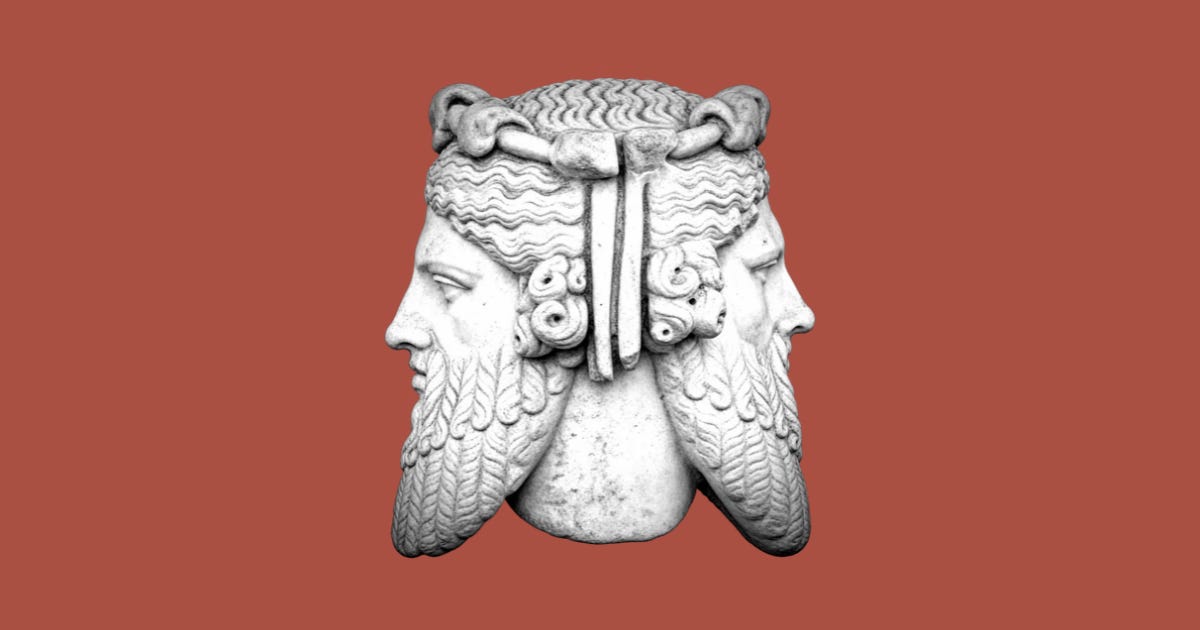
After a brief introduction, the Fasti begins (how else?) with Ovid interviewing the god of beginnings and endings: the anceps (two-headed) Janus, whom Ovid asks about the first day of the year’s first month. As you may have guessed, this is the month named after the god himself: January. Ovid’s investigation of the Roman calendar thus gets kicked off, quite naturally, with the Kalends (the name the Romans gave to the first day of the month) of January.3
Janus appears to Ovid, frightening in his two-headed form, and announces that he is Chaos itself. Despite his terror, Ovid chances a series of questions, wishing to leave no holiday custom unconsidered. One of the Roman customs on January 1st was gift-giving. Ovid asks Janus why Romans exchange well-wishes and give out sweets and coins on that day.
Good or bad luck, Janus tells Ovid, are found in beginnings. So we wish our neighbors well and attempt to make their year sweet with strenae, sweet gifts of dates and figs and honey. And as for the coins we give out—well, what is sweeter than money?
People have always loved money, Janus allows, but nowadays that love has reached such a height it probably cannot be surpassed.
As the eye of Janus’ mind beholds the avarice of the modern Roman, it then glances back to Rome’s humble beginnings, when Romulus slept in a reed bed within a small hut. Readers of Livy’s history of Rome will recognize some of what appears in Janus’ speech: In her poverty, Rome was virtuous, but now that wealth has rushed into the city, so has vice. In the good old days, Jupiter himself could hardly fit inside the humble temple made for him. But now, what was once decorated humbly with leaves is covered with gems.
Of course, the splendor is not all bad, Janus admits, since gold suits a god. Two-headed Janus is, you might say, of two minds, and so he speaks with two mouths. Is it a contradiction to laud the poverty of Roman rites in the age of the city’s founding but also to accept with pleasure its later opulence? Janus thinks not; both ways possess their own dignity. He explains this two-mindedness with the line that inspires this publication:
laudamus veteres, sed nostris utimur annis
‘Antiquity we praise, and yet we live in our own time’
In antiquity, we encounter great heroes whose virtues and triumphs have the power to awaken great things in those who study them. They are exemplars of strength and courage, models fit for both contemplation and imitation. Alongside their stories, and sometimes intermixed with them, we find great villains too, and the tragic failings of otherwise great men, whose vices and failures furnish warnings for those who heed them.
When we study the ancients, we also behold the masterworks of great artists, inspired, it seems, by muses of superhuman origin. Generations of poets and painters and sculptors and artists of all varieties have returned to these masterworks again and again to hear the songs of the past as they fashion their own art for the present.
And in our investigations of the past, we come upon the wisdom of great philosophers and scholars, sages and priests, prophets and saints. Their lessons are given freely to anyone today who wishes to appropriate them from the dialogues, fragments, writings, and stories in which they are found, and to assimilate them into their minds so that they might go and do likewise.
Looking backwards and forwards
Like Ovid’s Janus, we find much to praise in antiquity. Indeed, if there were nothing worth praising in ancient times, we would not study ancient languages, read ancient literature, or study ancient history.
The ancient languages themselves are like maps of infinite resolution. In the study of a language, a vast territory is spread out before you, and no matter which point on the map you pick to zoom in on, you will find ever more detail, further contours to trace, another site and another name.
And yet the languages themselves are only the beginning. Their great power is embodied in the flesh of the poems and histories and tales and speeches composed in those languages. Some ancient works, like the Fasti, have seen their popularity rise and fall (and rise again!) over the course of centuries. Others, especially those of an epic scope like Homer’s poems and Virgil’s Aeneid, have had a more consistent reign over the minds of those interested in the past.
Ovid himself is most renowned for his own epic, the Metamorphoses, which tells the story of the world from its beginning all the way to the apotheosis of Julius Caesar. Along the way, we encounter many familiar gods and heroes, tellings and retellings that have indelibly formed our imagination of the Greco-Roman past and its mythology.
While we know the great Trojan prince Aeneas from Virgil’s Aeneid, that is not the only place he shows up. Aeneas also appears in other works from Ancient Rome, including the Metamorphoses. In book 14, Aeneas and his crew arrive at last in Italy and are surprised to meet an Achaean named Macareus, one of the companions of Ulysses (“Odysseus” to the Greeks). Macareus tells Aeneas and his crew of the Achaeans’ misadventures with Circe, the sorceress who had turned Ulysses’ men into pigs. After relating the story of the foul witchcraft of that Titan’s daughter, Macareus explains why he has ended up in Latium:
ancipitesque vias et iter Titania vastum
dixerat et saevi restare pericula ponti
‘The Titan’s daughter had told us of
the ancipites paths, the vast journey,
the dangers of the savage sea
which still awaited us’
Here we see another use of the word “anceps.” An anceps god is two-headed; if paths are ancipites (the plural form of anceps) they are forked, unsure, treacherous. Macareus and Ulysses are not the only heroes of antiquity who travelled viae ancipites (uncertain paths). Uncertainty and danger lurk in so many of the memorable texts from the past: Beowulf traversing the whale-roads of Scandinavia to fight monsters, Aeneas’ flight from Troy bearing his ancestral gods and the destiny of his people, the long march of Jesus of Nazareth towards the Place of the Skull.
This is another reason we are calling this publication Anceps. We love these stories of uncertain, treacherous paths and we want to walk those paths with our readers, and encourage them to explore those ways and byways themselves.
Epic tales of viae ancipites, however, comprise just a slice of the broad spectrum of literature from times past. For example, the Roman Neoteric poets, the literary avant-garde of the 1st century BC, generally spurned the grandiose and epic style of their predecessors in favor of small, tight, lyrical poems of great elegance and subtlety.
But Catullus, our foremost exemplar of the Neoterics, is for the most part read and studied only by Latin students and classicists—unlike poets like Virgil and Ovid, who are much better known among non-specialists in comparison, and who are better-represented on undergraduate “Great Books” reading lists.
Classics are classics because they are, as Thucydides wrote boldly (and, as it turned out, correctly) of his own work, an inheritance for all time. Great works do not go obsolete, but sometimes our ability to appreciate them does.
On the one hand, this makes sense in the case, e.g., of Catullus. Like many ancient works, lyric poetry requires some introduction for the casual reader, and further, much of its charm is present in its sound, something that cannot be reproduced in translation.
Greek and Latin poetry is built with quantitative meter: which syllables in a line are long, or short, or undecided. These undecided syllables are called syllabae ancipites (anceps syllables). An anceps god is two-headed; an anceps road or path or situation is doubtful or dangerous; an anceps syllable in a metrical scheme is undecided, one that could be long or could be short.
With Anceps, we will be looking backwards and forwards, like Janus, whom the vates Ovid addresses, saying to him that alone of the gods, he sees his own back.4 While praising the past, we will also “make use” of the present, which has its own pleasures of course.5 But as we have found, making use of the present is also a source of a deeper enrichment of the past.
The strenae, the Roman custom of gift-giving on the Kalends of January, might sound merely like a historical curiosity, distant but charming like other Roman customs and their associated artifacts like the toga praetexta, the white toga fringed in purple, worn by Roman children and by high-ranking priests and politicians. So it seems until we learn that the strenae described by Ovid in the Fasti are alive and well in France, where children sometimes still receive gifts and service workers get tips and bonuses on New Year’s, a custom the French know by the word étrennes, the direct descendant of the Latin strenae.
Anceps will also venture onto the viae ancipites of fantasy and history, leading our readers through the epic stories of the past—historical and mythical.
And we will invite our readers to understand and appreciate those seemingly out-of-reach aspects of ancient language and literature, those things, like the technicalities of poetic meter, that might leave the casual reader feeling unsure. Anceps is here to bring aid to the anceps!
This publication is an extension of the work we do at the Ancient Language Institute, and a further effort to accomplish our mission: to aid students in their path to proficiency in ancient languages, to improve the way ancient languages are taught, and to foster a rebirth of the humanistic tradition.
Every week, we will publish something new on Anceps. We will share essays about ancient literature, classical education, language teaching, and linguistics, written both by our own staff as well as by exemplary writers and scholars from outside the Ancient Language Institute.
We will also be running virtual book clubs to walk readers through classic works, featuring study guides and live discussions open exclusively for paying subscribers. Our podcast, New Humanists, is also moving to Anceps, and paying subscribers will get access to New Humanists+ bonus episodes, among other things.
We hope you will read and listen along, with one head looking back to the past, and one head facing forward to see the present.
The other two are Horace and Virgil.
Vates, interestingly, is cognate with the wōd- of Wōden, which means, etymologically at least, “lord of frenzy”.
Not only does “January” come from Janus; our word “calendar” comes from Kalends.
Iane biceps, anni tacite labentis origo, / solus de superis qui tua terga vides
In the line laudamus veteres, sed nostris utimur annis we find the verb utimur, which can also mean “we use”; our English word “use” is a descendant—through French—of this Latin verb.